CKD for Primary Care Prescribers

Boehringer Ingelheim has provided funding towards this education, training, and mentorship programme. Boehringer Ingelheim has had no editorial input into or influence on the agenda or content of the programme, including any supporting materials, and has not been involved in the selection of speakers, trainers, or mentors.
Course overview
This course provides a practical approach to CKD in primary care. It centres on medicines optimisation, but covers the full journey from prevention to referral.
  • Modules: 6
  • Short modules: 20-30 minutes
  • Audience: Primary Care
  • Study time: 3 hours
  • Quiz and Certificate
Date of preparation: December 2025
Write your awesome label here.
Due to pharmaceutical content, access to this course is restricted to healthcare professionals only.
This course is currently in a beta phase. The content is complete and ready for use, but we are actively seeking feedback from primary care prescribers to help refine and improve future versions and to steer the content of future primary care materials. If you have suggestions or spot anything that could be clearer or more useful in practice, we would value your input.

About the course

Chronic kidney disease (CKD) affects about 1 in 10 UK adults. It is a lifelong condition with wide-ranging consequences, including substantially increased risks of cardiovascular events, progression to kidney failure, and all-cause mortality. Preventing CKD, detecting it early, and managing it well helps people live longer, healthier lives while reducing long-term economic impact.

Most people living with or at risk of CKD will never need to be referred to secondary care. Primary care prescribers play a central role in reducing the cardiovascular disease and kidney failure risk with the appropriate use of evidence-based, cost-effective medication.

This course provides a practical approach to CKD in primary care. It centres on medicines optimisation, but covers the full journey from prevention to referral.

Learning outcomes

You'll learn how to:

Recognise CKD and explain its significance

Define CKD, distinguish it from acute kidney injury (AKI), and describe its prevalence, impact on patients, health outcomes, health inequalities, and costs to the healthcare system.

Explain kidney function, damage, and complications

We guarantee you an exceptional experience with flexible learning paths and professional guidance

Detect, stage, and stratify risk

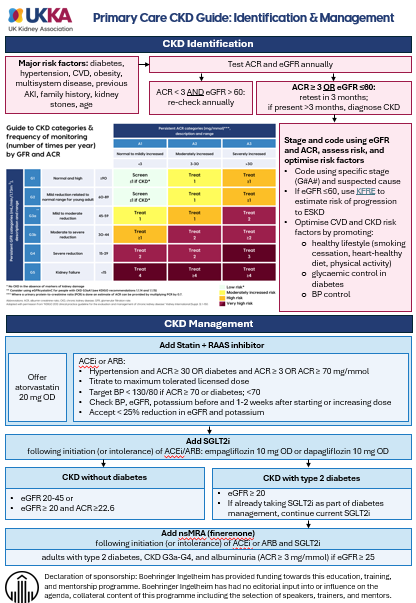
Use estimated glomerular filtration rate (eGFR) and urinary albumin-creatinine ratio (ACR) together to diagnose and stage CKD, apply coding and case-finding tools in practice, and use the Kidney Failure Risk Equation (KFRE) to support risk stratification. Apply these to guide shared decision-making on prevention, monitoring, management, and referral.

Optimise medicines

Apply a stepwise approach to medicines optimisation (lipid-lowering medications, RAASi, SGLT2i, nsMRA), understand different blood pressure (BP) target thresholds, adjust dosing safely using creatinine clearance, minimise medication-related harm, and support adherence in collaboration with patients and kidney teams.

Recognise complications and support long-term care

Recognise CKD complications and know when to refer (including anaemia, metabolic acidosis, mineral bone disorder, hyperkalaemia, and fluid overload). Apply lifestyle, dietary, and person-centred strategies to improve outcomes and quality of life.
By the end of this course, you will be able to apply what you've learned in your everyday practice to improve outcomes for people at risk of or living with CKD.

Prescribers should always consult local formularies, individual SmPCs, and relevant guidelines for full prescribing information.

The Authors

  • Dr Rupert Major - Associate Professor at University of Leicester, Honorary Consultant Nephrologist at University Hospitals of Leicester NHS Trust and Leicester, Leicestershire and Rutland Integrated Care Board; Integrated CKD Clinical Co-Lead at the UK Kidney Association
  • Clare Morlidge - Consultant Renal Pharmacist at the Lister Hospital in Stevenage and President of the UK Kidney Association
  • Sara Perkins - Highly Specialist Pharmacist, Renal and Transplant at North Bristol NHS Trust and Editor in Chief of the Renal Drug Database/Handbook at the UK Kidney Association
  • Cathy Pogson - Specialist Renal Pharmacist at Queen Alexandra Hospital and NIHR Fellow
  • Dr Kristin Veighey - NIHR Academic Clinical Fellow in General Practice, Associate Director of the Southampton Academy of Research at University Hospital Southampton, and Integrated CKD Clinical Co-Lead at the UK Kidney Association

Course Lessons